
RPIC District Digital Module 7: Re-Align Staff and Students
© 2012 to 2026. Elise M. Frattura and Colleen A. Capper. District Digital Modules for ICS Equity. All rights reserved. You may not reproduce, modify, or distribute this work without written consent from the authors. Please email info@icsequity.org to obtain such permission.

Learning Targets
- The District Office Organizational Structures and Practices is realigned to support all learners in a comprehensive manner.
- The District Office completes an analysis of the placement of Students in Non-Home Schools and Classrooms as a result of Special Education, Advanced Learners, English Language Learners, or other At-Risk Identifiers and creates a plan for proportional representation in the schools and classrooms students would attend if not identified.
- The District Office completes an analysis of the Pull-Out Practices and Services in Resource, Self-Contained, and Lower Tracked Classrooms as well as Ability Grouping School Co-Plan to Co-Serve to Co-Learn Teams and Proportional Representation.
- All schools have created their realignment in support of Co-Plan to Co-Serve to Co-Learn (C3) Teams with a clear timeline for implementation upon the completion of sharing out all the information within the School Digital Modules.
1. Current Practices Based on Common Assumptions
Across the country in most School District Offices, there are historical organizational structures in place that protect and maintain the status quo. These structures and practices result from the structures that often reinforce a norm that does not represent our students, families, and communities. Those structures are as follows:
- District Office Organizational Structures and Practices
- Placement of Students in Non-Home Schools and Classrooms as a result of Special Education, Advanced Learners, English Language Learners, or other At-Risk Identifiers
- Pull-Out Practices and Services in Resource, Self-Contained, and Lower Tracked Classrooms as well as Ability Grouping
- Realignment in support of Co-Plan to Co-Serve to Co-Learn (C3) Teams
A. District Office Organizational Structures and Practices
District Office leadership must begin with an analysis of traditional organizational structures (e.g., student services, curriculum and instruction, business services) within the District Office. Across the country, many District administrators lead the transformation within the schools, without concurrently completing an objective analysis of what they, as an organizational structure, symbolize and hold in high regard. In many cases, District Office administrators separate and even provide mixed messages and a lack of modeling of the transformation from a deficit-based system to a proactive system.
When we seek to co-create schools that are successful for each student, while maintaining a District Office by discipline-specific departments, we create a barrier to proactive services within the District’s schools. Thus, it is imperative to review the current structure of the District Office. As discussed in District Digital Module 1, the majority of school district administrative offices continue to be organized into traditional departments including, but not limited to:
- Superintendent
- Curriculum and Instruction and Curriculum Coordinators
- Student Services and all Support Coordinators
- Special Education/and Other Federal Programs
- Assessment and Data
- Human Resources
- Business Office
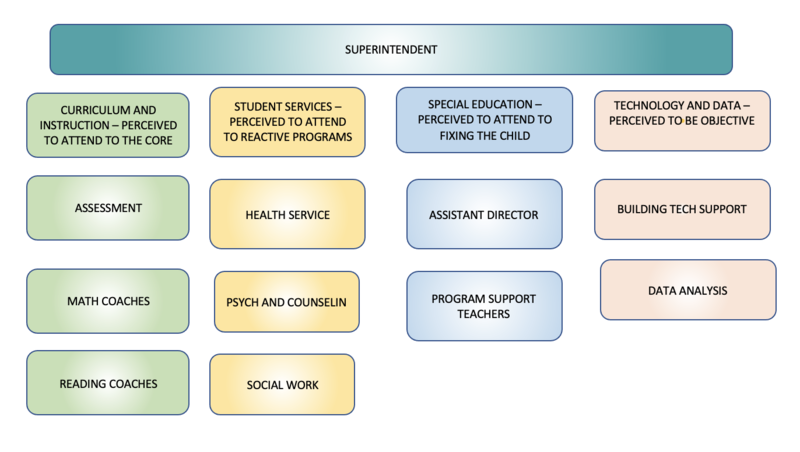
Such structures often reinforce separate programs for students with disabilities, advanced learners, at-risk, linguistically diverse, etc., rather than leveraging a unified system of services for all students under Teaching and Learning. Within these traditional structures, the parameters of administrators’ roles, the person(s) to whom they report, and how they spend their day, define what is valued and perceived as the core focus of the District. For example, Student Services and Special Education and Curriculum and Instruction are often not connected to each other and traditionally function within their separate silos. Many District Office teams reflect an organizational model that is similar to the example below in Figure 1.
Figure 1: Traditional Organizational Chart for a School District
Admittedly, equity-oriented change can be difficult for many people. The more entrenched one’s knowledge base and comfort level, the more difficult change may be. Many variables have perpetuated the practice of District Office administrators continuing to function from the protected silo model. We list the following six reasons often shared to perpetuate the District Office by disciplines:
(a.) lack of preparation;
(b.) certification and license parameters (perceived legal parameters), especially those of student services directors;
(c.) past experiences;
(d.) structural constraints;
(e.) the current K–12 model
Yet, if the district believes in creating a community of learners that embraces high expectations within a context of belonging, then the full participation of District Office administrators in modeling proactive practices is imperative.
B. Non-Home Schools and Classrooms as a Result of Special Education, Advanced Learners, English Language Learners, or other At-Risk Identifiers
Students who spend the least amount of time in the core of teaching and learning continue to fall further behind their peers during each year of their educational experience. Specifically, students of color, with a disability, who are linguistically diverse, and/or experiencing poverty are often the students who receive their educational “opportunities” someplace else other than the core of teaching and learning. When this occurs, students are both symbolically and in practice told that they do not belong to the “normed group of students” and the students within the normed group are also told who belongs and who does not. Every year a student is removed from the core of teaching and learning, reinforces a stereotype threat. The more marginalized a student is, the more the opportunity to take an advanced placement class becomes an impossibility. Upon graduation, if the student graduates, the cycle of marginalization is then reinforced, often across generations.
There are five primary practices within school districts that work to reinforce marginalization:
- District placement of a child in a specialized school other than the one they would typically attend as their home school or school of choice.
- Clustering students in specific schools (within or outside of the district) by an identifier, such as, but not limited to, Special Education, English Language Learner, At-risk, Gifted and Talented, etc. Practices of clustered schools and classrooms marginalize students by creating “placements” in the child’s non-home school – or the school they would attend if not labeled (e.g., disability, ELL, gifted, or at-risk) or parent choice.
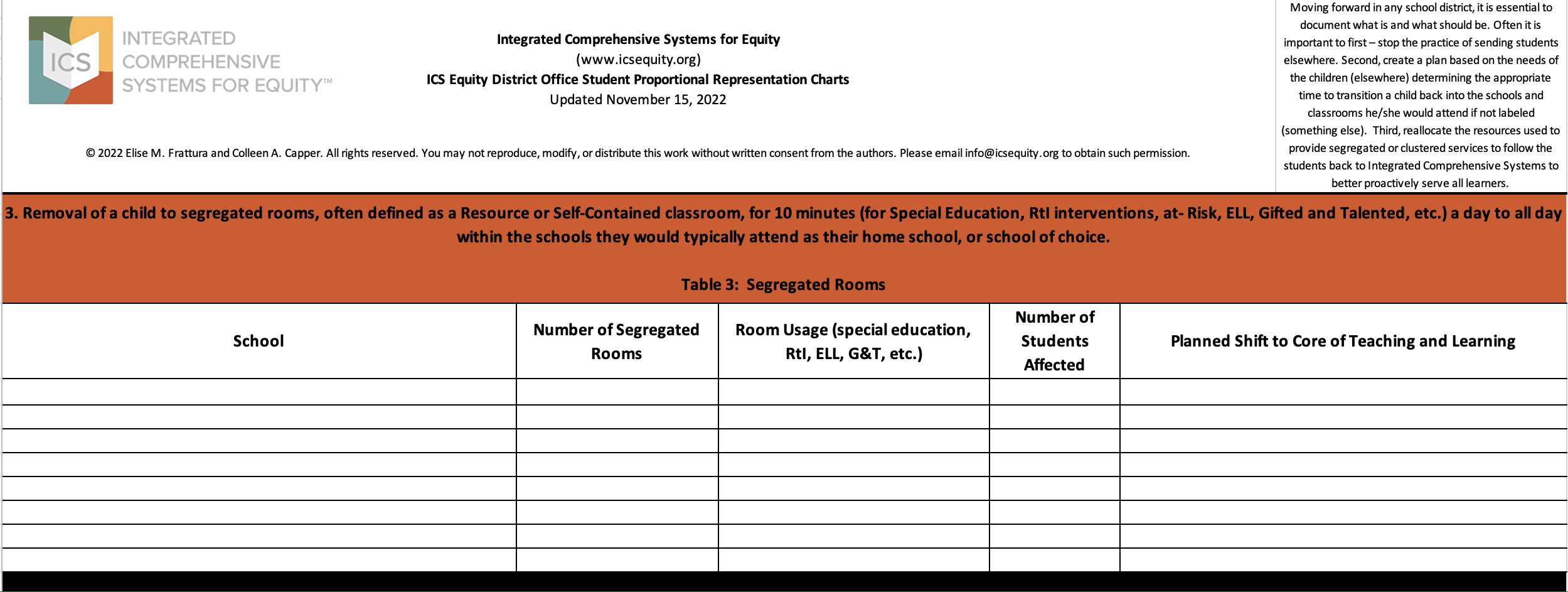
- Removal of a child to segregated rooms, often defined as a Resource or Self-Contained classroom, for 10 minutes a day (for Special Education, RtI interventions, At-Risk, ELL, Gifted and Talented, etc.) to all day within the schools they would typically attend as their home school or school of choice.
Once in the school, a child would attend if not labeled (e.g., at-risk, special education, linguistically diverse, etc.), reinforcement of practices of ability grouping at the elementary school and lower class tracks perpetuate marginalization.
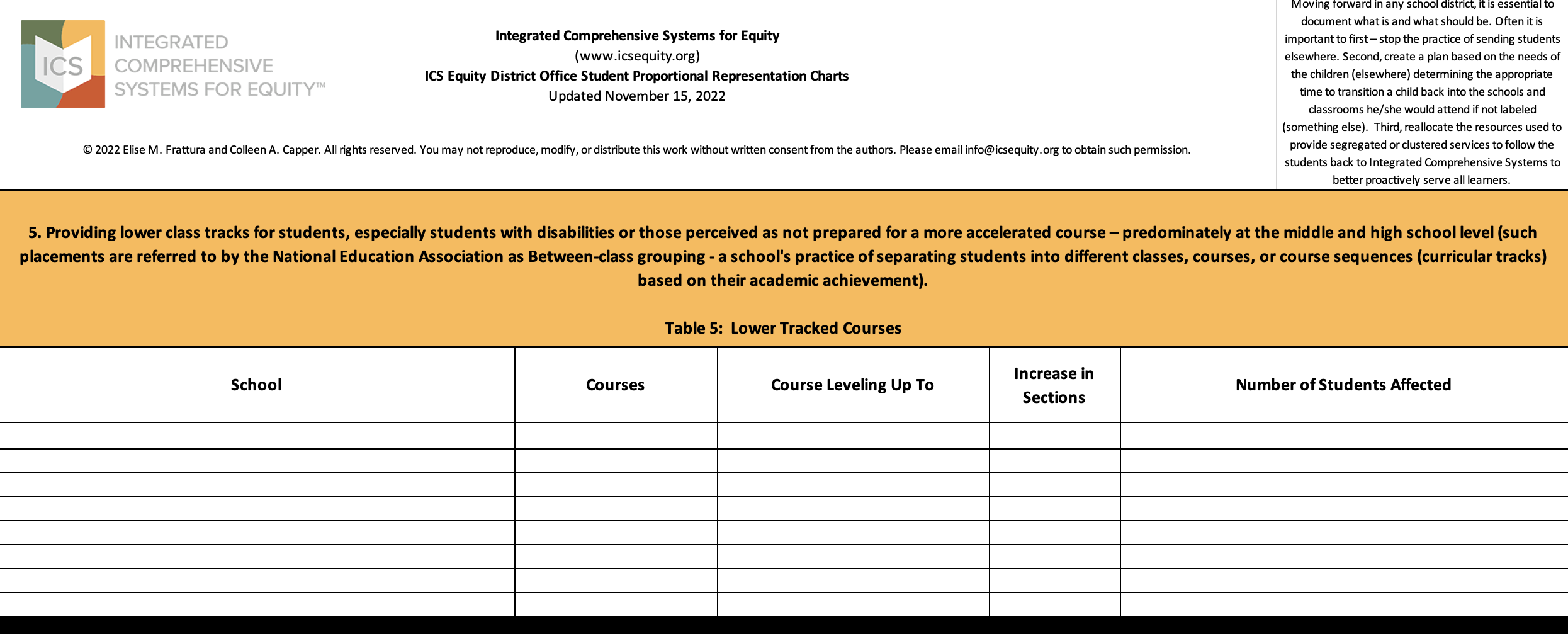
- Providing lower class tracks for students, especially students with disabilities or those perceived as not prepared for a more accelerated course – predominately at the middle and high school level (such placements are referred to by the National Education Association as Between-class grouping – a school’s practice of separating students into different classes, courses, or course sequences (curricular tracks) based on their academic achievement).
- Ability grouping within the core of teaching and learning (such placements are referred to by the National Education Association as Within-class grouping – a teacher’s practice of putting students of similar ability into small groups usually for reading or math instruction).
In 1988, Dr. Frattura wrote about home school with Dr. Lou Brown and defined it in the following manner:
A home school is the one a student with disabilities [or other labels] would attend if he/she were not disabled [labeled]. A clustered school is a regular school attended by an unnaturally large proportion of students with disabilities [or other labels], but it is not the one most would attend if they were not disabled [labeled]. Students with disabilities [or other labels] should attend home schools so that:
- all children can be prepared to function in a pluralistic society.
- the most meaningful and individually appropriate instructional environments and activities can be used.
- parents, guardians, brothers, and sisters can have reasonable access to schools and services; and,
- a wide range of social relationships with students and others who are not disabled [or other labels] can be developed, maintained, and enhanced over long periods of time.
Location, where students are physically placed to learn, is a central distinction between segregated (including pull-out) programs delineated above and a proactive system where all students have access to high-quality teaching and learning absent any experiences of marginalization and oppression. Specifically, through how they are perceived, location of instruction, curriculum, pedagogical practices, policies and procedures, and funding. Under a segregated program model, educators believe that the primary reason for student failure is the student themself. This perception has been reinforced through a deficit-based lens, where it is reinforced that students cannot be helped until they fail and receive a label of some sort (e.g., at-risk, disability, Tier 2 or 3, English language learner, etc.), and then that a licensed expert must then provide the necessary and appropriate supports. The result of such an arrangement is increased dependency on a reactionary system.
Further, clustering means that specific identifiers are used to cluster students in a classroom or program in numbers greater than their proportional representation within the school. In the case of students with disabilities, typically a special education teacher is then assigned to support the students in a special classroom and perhaps two to three other classrooms where students with disabilities are clustered. For students who are linguistically diverse, supports for students eligible for English Language services are often clustered in specific schools and then classrooms within the schools. Families of students who are linguistically diverse are encouraged to have their children attend if they wish to receive support. When students are clustered, with an unnatural proportion of students with specific identifiers within one school, it is difficult to develop a proportional representation of all students within each classroom that mirrors the student demographics of the district.
In addition, segregated practices persist because many educators believe it is more cost-effective for educators to cluster students with similar labels in particular classrooms or particular schools. Moreover, this particular administrative arrangement makes little sense with the current federal support for cross-categorical services. That is, now State Departments of Education are issuing special education teaching licenses for teachers to be able to teach across special educational categories. Thus, school districts can no longer use the argument that only particular teachers can provide particular support for particular students.
Often educators in such settings believe that students in segregated programs can only be educated in a situation that is separate from the student’s peers. Reasons for this assumption include several arguments, for example: that a middle school student would feel embarrassed to receive speech articulation training in front of their peers, or that if elementary students require intensive reading instruction, then this instruction requires a separate setting, like a Title I or Reading Recovery room. Educators reason that this saves the student from the embarrassment of reading in front of their more “capable” peers and that a separate room cuts down on classroom distractions. Surely there are times when students would need privacy – no different than anyone else in society.
Ironically, often under segregated program assumptions, “inclusion practices” evolve into another segregated program — i.e., the segregation of inclusion. Segregated inclusion happens when students with disabilities are disproportionately assigned to, or clustered in particular classrooms. For example, in a school with four third-grade classrooms, students with disabilities are clustered into one or two of these classrooms in numbers that result in a higher percentage of students with disabilities in these classrooms than the percentage of students with disabilities in the school. Educators argue that these practices are legitimate because it then becomes more convenient for special education staff to support students across fewer classrooms. We have witnessed educators in these schools calling these particular classrooms “the inclusive classrooms” or “inclusion programs” and the students with disabilities in these classrooms “inclusion” students. In so doing, these classrooms and students, under the guise of inclusion, inherit yet another set of labels. Educators reason that if a practice is more convenient for staff, then students will receive higher quality services in these segregated arrangements. In the schools, unfortunately, while clustering students may be more convenient for staff, this model does not build teacher capacity. That is, the “inclusion” and “transition” teachers increase their capacity to teach to a range of students, while all the other teachers in the school are “off the hook” with no incentive to gain these skills, resulting in higher costs and less effective in the long run.
The cost of segregated programs comes in many forms, from administration and overhead, to transportation, tuition, salaries, and therapy supports. Often tuition costs for segregated programs are over $20,000 a year per student, not including transportation, therapy, and other costs. Transportation to and from segregated environments is an additional cost that could be better used to provide proactive support staff for all learners. One must also ask, why school districts use specialized buses, often inappropriately called “the short bus”, when almost every community across the U.S. and other countries have hydraulic lifts on their city buses. Should we not expect our educational transportation companies to also have hydraulic lifts to support students using wheelchairs coming to and from school, field trips, and extra-curricular activities? School Districts will pay hundreds of thousands to millions of dollars to send just a few students to a segregated environment, but not add the additional dollars to retain the same child within the school and classroom they would attend if not labeled with a disability.
Others state that parents and families are requesting segregated options. Given the history discussed in earlier Digital Modules, it is clear that practices in education have taught every generation of children, who belongs and who does not. Parents and families are scared. They first and foremost, want their children to be wanted by staff and students. When districts can support the Equity Non-Negotiables, language, understanding, and compassion shift to an assets-based lens, families can also support and advocate for the benefits of an assets-based integrated and comprehensive system for their children.
As Dr. Lou Brown stated almost 30 years ago “segregation begets segregation.” Students who are moved to other schools are students of poverty, disability, color, and linguistically diverse. The financial burden that school districts are willing to support to create these programs to no avail is alarming. The amount of money school districts are willing to pay for these practices of removing students from the schools and neighborhoods where they live, learn, play, and grow up, is even more alarming.
C. School Co-Plan to Co-Serve to Co-Learn Teams and Proportional Representation
Many districts and schools move quickly to supporting classroom settings through a deficit-based co-teaching model, premised on clustering students with disabilities in specific classrooms, without realigning staff to Co-Plan to Co-Serve to Co-Learn (C3) Teams. If students are not proportionally represented and staff have not been realigned to proactively educate the natural proportions of all learners at each grade level across content areas – achievement will not improve and we will not recognize the gifts inherent in our diversity.
D. Realignment in support of Co-Plan to Co-Serve to Co-Learn (C3) Teams
This is the most difficult step in the work, to be proactive and equitable, as it asks us to change our structures and practices. District Office administrators must lead such a transformation pragmatically and compassionately. It is no longer about placing district-wide band-aids but instead requiring each adult to transform their way of thinking about themselves, students, and their practices. Such an expectation requires educators to understand their own assumptions. As discussed in Digital Module 3, all educators must own their own biases. What if we do not believe that students experiencing poverty can excel as much in school as children from affluent families? What if we really believe that students who are African American present more behavioral challenges for educators than students who are white? What if we believe that students identified with a disability actually will not excel? What if we believe that students who are linguistically diverse hold the class back and should be educated someplace else? Our assumptions or perceptions define our educational structures. If you are an administrator reading this Digital Module and such statements ring true for you – we encourage you to step back, to spend more time thinking and learning about how we have been socialized to hold such false assumptions, and to acknowledge the impact of such assumptions on all students.
In this manner, we have an opportunity to objectively assess how we have been socialized and what perceptions are assets-based and those that are not. We are then better able to lead the work of realignment. As we know, the schools can only evolve to a level of social justice that the school and district leaders have come to understand.
2. Future District Considerations
A. District Office Organizational Structures and Practices
District Office leadership must redesign the District Office to mirror the proactive structures necessary within each school, in support of an integrated and comprehensive system. Such a redesign would require the District Office to move from a deficit-based structure (as reflected in Figure 1 above), to an asset-based structure (as depicted in Figure 2 below).
Transforming from disciplinary silos in the District Office to Teaching and Learning for All remains a large task. For any change to be successful, the change should start small. At the district administration level, merging roles and responsibilities can occur for specific agendas, initiatives, reports, or other sequential/concrete tasks they must accomplish. For example, on completion of the analysis between the student services director and the curriculum and instruction director, two or three primary areas might emerge for which they can share ownership, such as diversity issues, standards, or assessment.
That being said, realigning the district infrastructure in support of Teaching and Learning for All Students is essential. Curriculum and Instruction and Student Services should be re-aligned either by enveloping Student Services into Curriculum and Instruction or by merging the departments side-by-side as a Teaching and Learning for All Students along with Human Resources and Communications.
Figure 2: Integrated Comprehensive Systems Organizational Chart for a School District
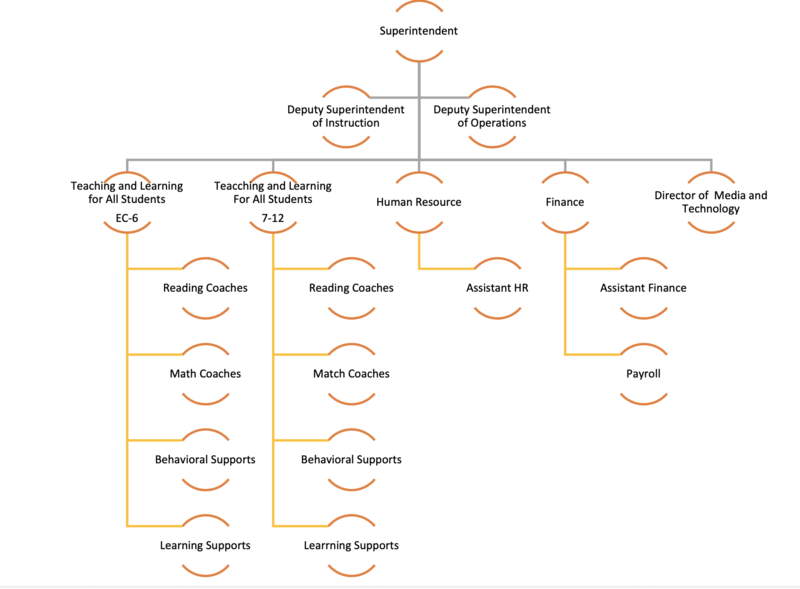
Often in a restructured District Office, that emphasizes equitable opportunities and outcomes for each student, the human resource and business manager can better schools by hiring professionals who are successful with a range of students. In this way, District Office educators are modeling the transformation from segregated programs to those that bring services to all students across the district. Such a model is transformed under teaching and learning for all students. This can be completed with a teaching and learning administrator for EC – 5th grade, 6th grade – 8th grade, and one for 9th grade – postsecondary, depending on the makeup of the district. In addition, all support staff such as coaches and learning strategists are then organized and work together as a team in support of proactive services for all learners.
The alignment of instructional coaches, special education program support specialists, title reading, and math specialists must be created to better support each school. More specifically, it will be important to create teams of specialists who work together across specific groups of schools. This may occur by elementary, middle, or through secondary groupings or across feeder schools. In doing so, the District Office maintains continuity of support for all schools.
B. Placement of Students in Non-Home Schools and Classrooms as a Result of Special Education, Advanced Learners, English Language Learners, or other At-Risk Identifiers
In a proactive system, all students attend the school they would attend if they did not have any educational identifier. This is a basic civil right. Students do not have to leave their peers in their classroom, school, or district to participate in a curriculum and instruction that meets their learning needs. At the district level, particular schools would not be designated the “ESL school” or “the school where all the elementary students with severe disabilities attend” or “the middle school that houses the students with severe challenging behaviors” or the “alternative education high school.” Accordingly, a school does not have rooms labeled the “Resource Room”, “LD ROOM”, the “CD ROOM”, the “ESL ROOM”, or even the “Tier 2 Students” or “AT-RISK ROOM.” Moreover, when a group of students travels on a field trip, it should not just be students with disabilities or who are “at risk” who are attending. Nor should it just be students without labels attending.
To interrupt practices of placing students in specialized schools, other than the ones they would attend as their home school, schools of choice, clustering students in specific schools (within or outside of the district), and/or removing a child from the core of teaching and learning to segregated rooms, district leadership must be clear as to the “why” behind the “what.” More specifically, the District Leadership Team must support the sharing out of the history of marginalization, identity frameworks, the asset vs. deficit lens, and the research behind the work of proactive educational systems prior to moving students back into the core of teaching and learning. We have found that each step that is missed within the process decreases the potential significance of student achievement. When teachers have not been realigned to form Co-Plan to Co-Serve to Co-Learn (C3) Teams the chances of success again decrease as a deficit-based structure within the schools remain. Therefore, it is imperative that the DLT move through the ICS Equity Digital Modules/Steps, as delineated within the Cornerstones, to better support a seamless transition from a deficit-based model to an assets-based model.
As districts begin their transformation it will be essential to discuss what the district is moving toward, versus what they are leaving behind. The following data will be essential to collect to have a better understanding of how many students are involved in a transitional plan to return to the schools and classrooms they would attend if not identified for a specific educational program.
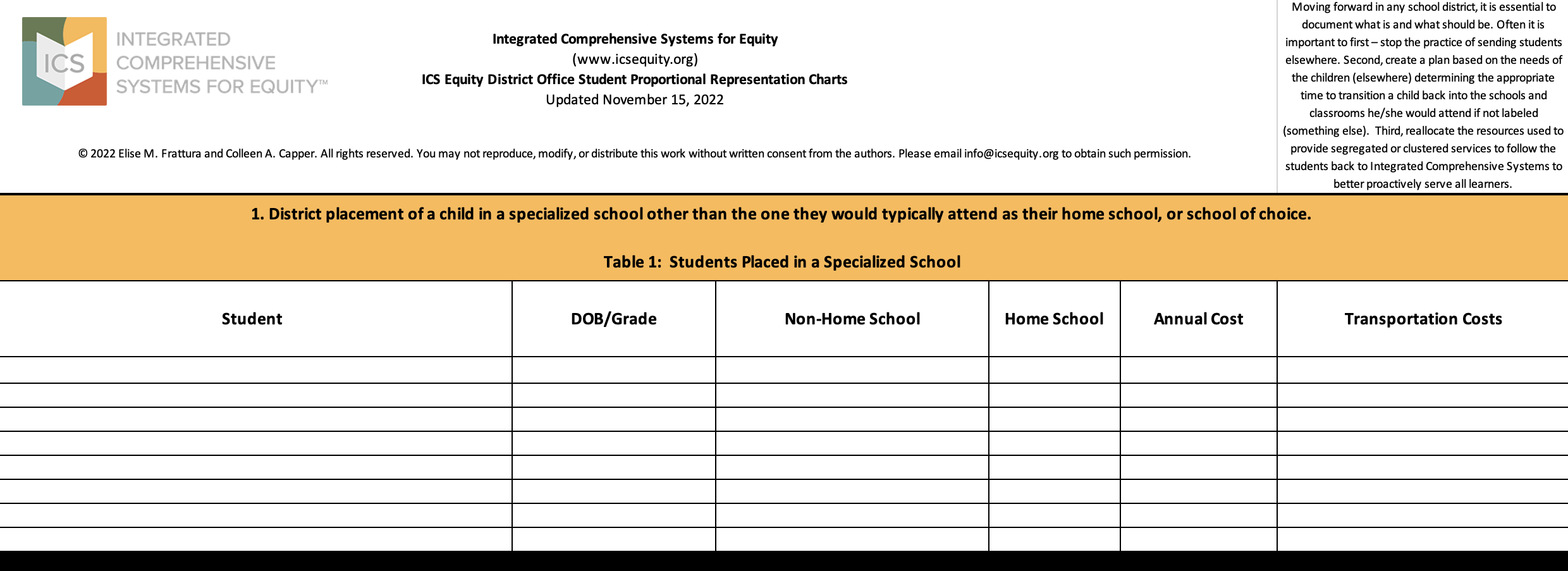
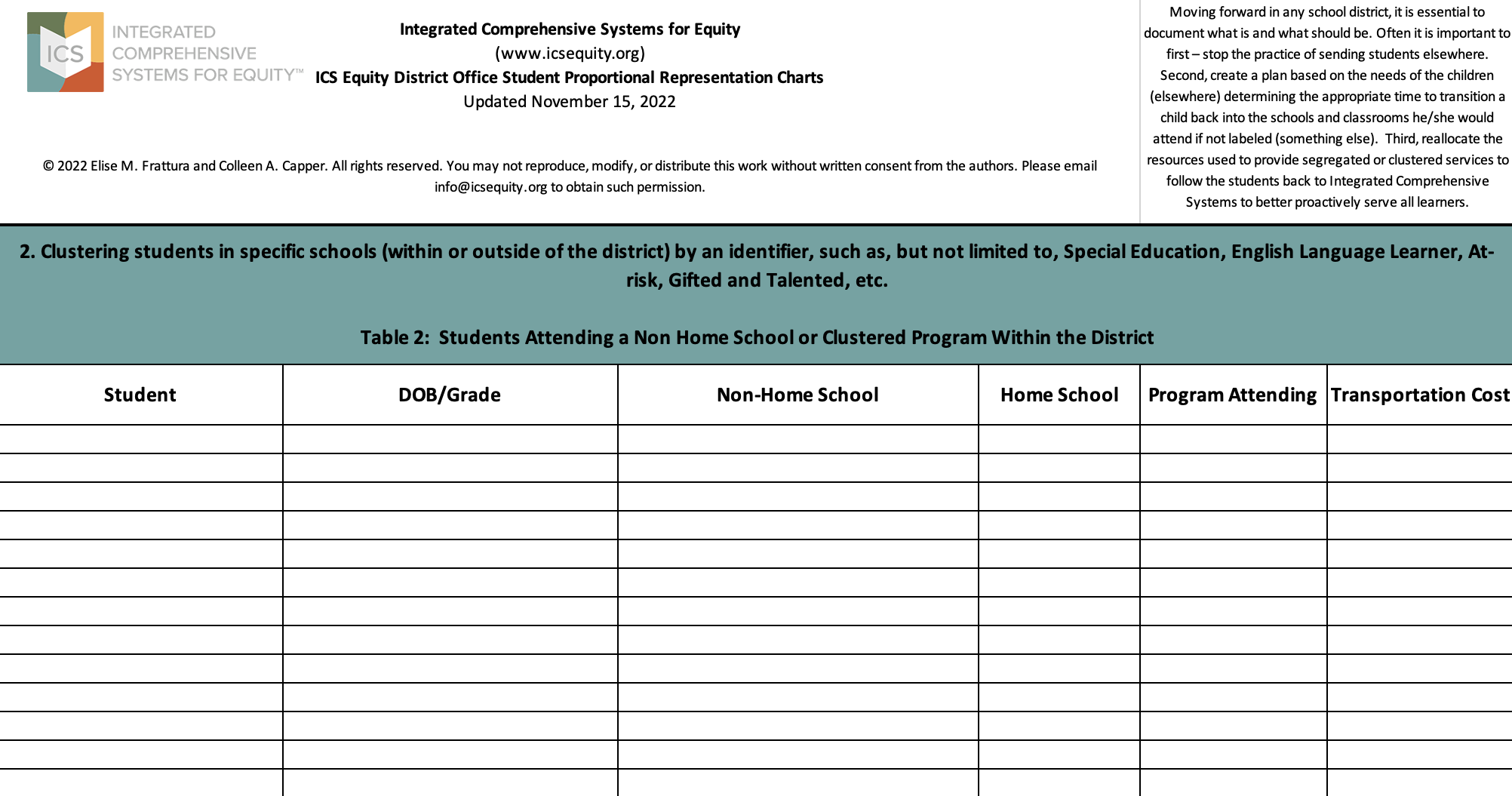
As discussed in District Office Module 1, the first step is to document the students in a specialized school, clustered programs, and/or segregated classrooms. Second, it will be important to determine what resources/staff should be reallocated to follow the students back to the schools and classrooms they would attend if not identified for a specialized school, clustered program, and segregated classroom. In addition, the excel file used is provided in the materials section of this Module as well as in Module 1 of the District Office modules. Third, it will be essential to create a multi-year plan based on the individual needs of each child and the functioning of Co-Plan to Co-Serve to Co-Learn Teams (C3) Teams to return children to the schools and classrooms they would attend if not identified.
- District placement of a child in a specialized school other than the one they would typically attend as their home school or school of choice.
Table 1: Students Placed in a Specialized School
- Clustering students in specific schools (within or outside of the district) by an identifier, such as, but not limited to, Special Education, English Language Learner, At-risk, Gifted and Talented, etc.
Table 2: Students Attending a Non-Home School or Clustered Program Within the District
- Removal of a child to segregated rooms, often defined as a Resource or Self-Contained classroom, for 10 minutes (for Special Education, RtI interventions, At-Risk, ELL, Gifted and Talented, etc.) a day to all day within the schools they would typically attend as their home school or school of choice.
Table 3: Segregated Rooms
C. Pull-Out Practices and Services in Resource, Self-Contained and Lower Tracked Classrooms as well as Ability Grouping School Co-Plan to Co-Serve to Co-Learn Teams and Proportional Representation
It will be essential for the District Office to complete an analysis of practices of ability grouping that occur within each school for MTSS as well as reading and math and create a plan to move toward heterogeneous grouping patterns over time.
Table 5: Ability Grouping

It will be essential for the District Office to complete an analysis of practices of tracking that occur within each school in all subject areas and create a plan to move to level up and increase proportional representation in upper-level courses through the use of Co-Planning to Co-Serving to Co-Learning Teams or C3 Teams.
Table 6: Tracking or Leveled Courses
In summary, the critical role that location plays cannot be overemphasized. As long as segregated settings, classrooms, courses, grouping, and schools exist, educators will find reasons to place students in these settings. With segregated programs, these settings reinforce negative assumptions about students and teaching and learning, and not only does this model not build teacher capacity, but it reinforces teacher and student dependency. Even more importantly, segregated programs are the most expensive and least effective way to serve students. Integration becomes a proactive means to break the vicious cycle of negative beliefs that then require segregated programs that in turn reinforce negative assumptions and beliefs. Student location dictates teacher location and the location of teachers and students in integrated environments lays the groundwork for all the other aspects of a proactive system for all learners.
C. Realignment in Support of School Co-Plan to Co-Serve to Co-Learn (C3) Teams
Lastly, it will be essential to realign staff and students in all schools to create Co-Plan to Co-Serve to Co-Learn (C3) Teams. The role of District Office leadership in this work is essential. First and foremost it will be essential to complete the work. The District Office must set the stage in a consistent and comforting manner by supporting the evolution of C3 Teams in all schools. Third, it will be essential for the District Office to confirm staffing across all schools, more specifically, there must be a transition plan in place for how all students will be transitioned back to the schools and classrooms they would attend if not identified under any specific category (such as but not limited to ELL, Special education, Alternative Education, Gifted and Talented or advanced learners, Tier 2 and Tier 3, etc.). Once such a plan is in place – it is imperative that the School Leadership Team (with support from the District Office) create a plan to realign all educators to allow new C3 Teams the opportunity to receive professional development as a C3 Team prior to serving a more diverse range of learners.
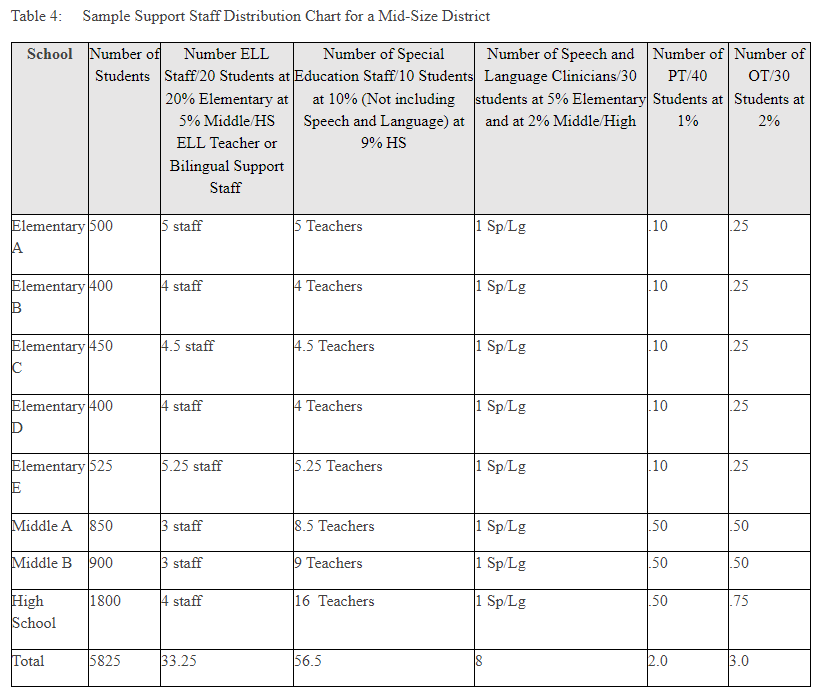
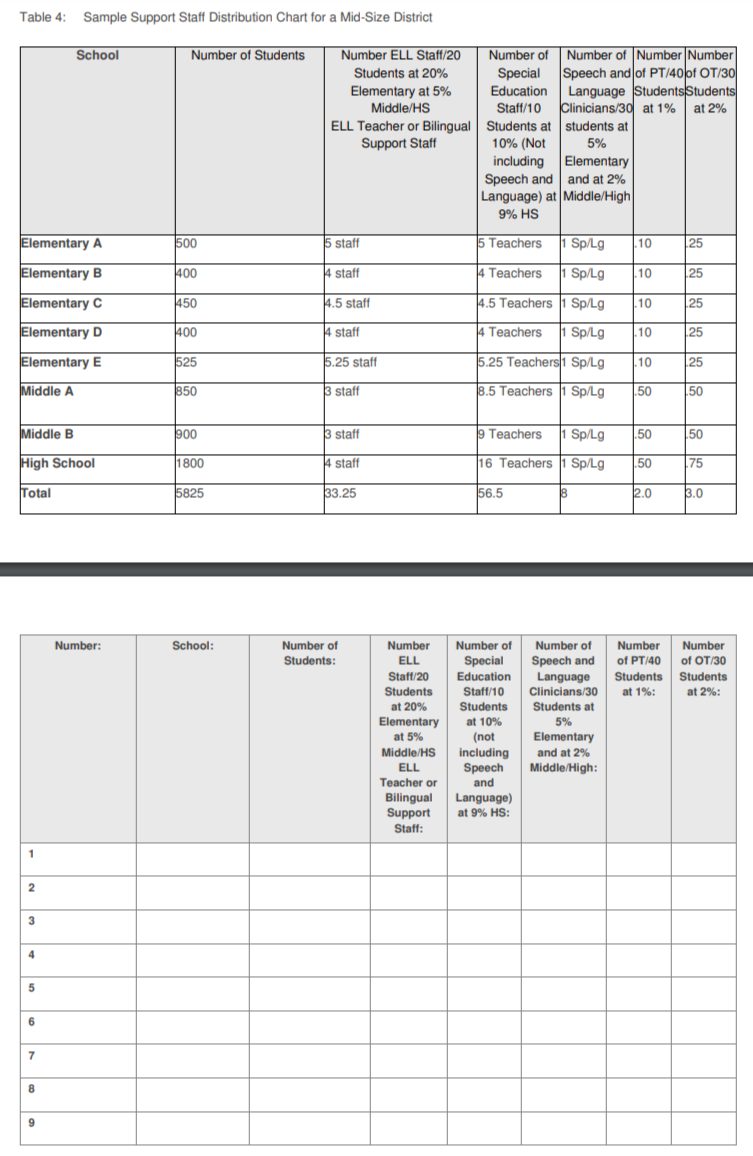
When schools are proportionally represented and there are no segregated or clustered programs within the district, a census-based staffing formula (Odden & Archibald, 2001) is often the most equitable way to support each school within the district. In this manner, the school is supported with staff as if 10% of the students have a disability, whether the actual percentage is 10% or not. By staffing in this way, staff are then better able to function in an assets-based manner versus a deficit-based or reactionary manner. If the district receives district-wide title supports, then such supports should be equally prorated across the district (e.g., speech and language, OT, PT, At-Risk, G&T, ELL, etc.). Table 4 provides a sample distribution chart.
Table 4: Sample Support Staff Distribution Chart for a Mid-Size District
Once a plan is in place to return all students to the schools and classrooms they would attend if not identified, the School Leadership Team (SLT) can create a staff realignment plan. It will be necessary for the District Office to support the SLTs in this process and confirm that plans are being created. Once a realignment structure is created to support Co-Plan to Co-Serve to Co-Learning Teams (C3 Teams) across the school, it will be necessary to then determine how such a transformation may occur. We strongly suggest that the SLT and DLT work on the steps under ICS Cornerstone 1 for at least one year. Toward the end of that year – it would be appropriate to create a plan to support proportional representation in every classroom and a realignment plan for all staff in support of the C3 Team Structures.
As provided in the Part II School Digital Module 7, the steps to realignment are provided below:
Next, we list each of the stages and steps the School Leadership Teams will work through to re-imagine and intentionally create Co-Plan to C0-Serve to Co-Learn (C3) Teams.
Stage 1: List the Staff and Certification
Table 1: Step a: In the ICS Application section, you’ll list all staff in the school (general and special educators, title staff, reading and math interventionist, Learners who are Learning English, at-risk, speech and language, advance learners support, etc.)

Stage 2: List the Student Data
- List all grade levels in your school
- List the number of students in each grade level
- List the number of students by disabilities, ELL, receiving Tier 2 and 3 interventions, and advanced learners
- Align staff to function as Co-Plan to Co-Serve to Co-Learn teams (C3) based on the needs of the students and staff expertise.
- Add FTE for related service staff
- Confirm appropriate certification
Schools were created for students who they believe represent the “perceived normative”, and segregated and marginalizing programs and practices were created for students outside of that normative. Therefore, it is essential when re-imagining the educational structure, to begin with how the school is currently structured, such as by grade levels, multi-age, courses, academies, etc. In the elementary example provided, the school is structured by traditional grade levels.
Table 2: Step b. In the ICS Application section, you’ll list all grade levels in your school

In Table 3, Step c, the School Leadership Team will list the number of students at each grade level. This includes any child that is educated in a clustered or separate program. Specifically, when we use the language “all learners”, we mean that every single child that attends your school and their specific grade level.
Table 3: Step c. List the number of students in each grade level

Step d includes any child that is educated in a clustered or separate program. Specifically, when we use the language “all learners”, we mean every single child that attends your school and their specific grade level.
Table 4: Step d. List the number of students by disabilities, ELL, receiving Tier 2 and 3 interventions, and advanced learners

In Table 5, Step e, the School Leadership Team begins the process of re-aligning all staff to specific grade-level teams. The alignment of staff is completed by acknowledging the needs of the students at each grade level, as well as the expertise of the general education teachers at each grade level. The most important goal is to create teams that have complementary skills across individuals.
As an example, if the content teachers assigned to that grade level do not have a strong reading background, then it may be important to align the reading specialist to that specific grade level team for a greater percentage of the time, and less time on a team where teachers have such expertise. As a second example, if there is a child at a specific grade level who has a specific need, such as autism, it will be important to align the special educator to that team who has greater expertise and certification (when appropriate) in the area of autism.
Table 5: Step e. Align staff to function as Co-Plan to Co-Serve to Co-Learn (C3) Teams based on the needs of the students and staff expertise.

In Table 6, Step f requires the School Leadership Team to list the related service staff that should be aligned to each C3 Team based on the needs of the students in that specific grade level.
Table 6: Step f. Add FTE for related service staff.

Lastly, in Table 7, Step h, the School Leadership Team confirms that all educators have the appropriate certification for the grade level in which they are assigned.
Table 7: Step h. Confirm appropriate certification

The following is a completed template for the realignment of an Elementary School to function in a proactive manner through Co-Plan to Co-Serve to Co-Learn (C3) Teams.
Table 8: Completed Example of Elementary Co-Plan to Co-Serve to Co-Serve (C3) Team

Stage 3: Co-Plan to Co-Serve to Co-Learn Planning Times
In Table 9, the School Leadership Team specifies when each C3 Team will meet to Co-Plan to Co-Serve to Co-Learn. Many schools work hard to provide consistent times for C3 Teams to meet. For example, meeting opposite specials, before or after school, during early release opportunities, etc. Scheduling time for co-planning is difficult, but is one task, if not the most important task, a School and District Leadership Team can address. When determining meeting times, it will be important to attend to those staff members who are split between two or more grade levels and thus schedule times meetings on different days and/or times. In this manner, all staff on all C3 Teams are consistently able to attend each Co-Plan to Co-Serve to Co-Learn meeting.
Table 9: C3 Team Meeting Times

Stage 4: Creating Proportional Representation in Tier 1/Every Classroom
The final step to Re-Align Staff and Students to C3 Teams includes creating a plan to proportionally represent all students in all classrooms (including students who are attending another school in your district or outside the district based on label or need), on paper first. Keep in mind that there are no segregated, clustered, pull-out or resource rooms or low tracked classes in your school when students are proportionally represented in the core of teaching and learning. We define natural proportions in detail in Digital Module 6/Step 6. We have provided an excerpt defining proportional representation from Digital Module/Step 6 below:
Proportional representation means that the demographics of students labeled for special education, for students identified for English Language Learning services, and identified for advanced learning or gifted services in the school are proportionally reflected in every classroom, course, activity, setting, or experience. For example, if 12% of students in the school are labeled with a disability, then no more than 12% of students in any classroom, course, activity, setting, or experience are students labeled with a disability. As another example, if 12% of the students in the school are labeled with a disability and 20% of the students in the school are linguistically diverse, and there are six third-grade classrooms, then no more than 12% of students in each third-grade classroom has a disability and no more than 20% of students in each classroom are linguistically diverse. Students who are linguistically diverse and students who have disabilities are equally assigned across these six classrooms to reflect their proportion in the school.
In sum, proportional representation refers to students labeled with a disability, students as labeled English language learners, and students as labeled gifted/advanced learners. We do not mean that students should be proportionally assigned to classrooms based on race, social class, gender, or other identifiers. We have found that if schools assign students labeled with disabilities, identified for English Language Learning services, or identified for gifted services, in proportional ways relative to their proportion in the school, then students will be more naturally heterogeneously placed by gender, race, and social class.
Digital Module 7/Step 7 – Junior High Schools and High Schools:
The Steps to realigning for Co-Plan to Co-Serve to Co-Learn (C3) Teams are described in the elementary example above, however, High Schools and Junior High Schools have additional steps for leveling up to proportionally represent all learners in Tier 1. Specifically, there are five stages and their associated steps for High Schools and Junior High Schools described below to assist teams in identifying courses to level-up, list staff and certification, and list student demographics by content areas and grade levels.
Summary of Stages/Steps for Junior High/School C3 Teams:
Stage 1: Develop a Level-Up Plan
Stage 2: List the Staff and Certification
Step a: List all staff in the school (often 3 different tables for the content specialist, support specialist, and elective specialist)
Stage 3: List the Student Demographic Data
Step b: List the number of students in each grade level
Step c: List the number of students by disabilities
Step d: List the number of students who are ELL
Step e: List the number of special educators per grade level, at-risk teachers, ELL, reading specialists, para-professionals, bilingual support staff, and interpreters.
Stage 4: Creating Co-Plan to Co-Serve to Co-Learn Teams (C3) by Grade Level and Content Areas
Step a. Identify the grade level and content areas that C3 Teams will be created
Step b. List the number of sections and content teachers for each subject at the grade level
Step c. List the staff that will be aligned to each team
Step d. Summarize the creation of the Co-Plan to Co-Serve to Co-Learn (C3) Teams
Stage 5: Creating Proportional Representation in Tier 1/Every Classroom
We provide a high school example for each of the Stages for which School Leadership Teams can clearly see how a Junior High School is reflected in the same process and example.
Stage 1: Develop a Level-Up Plan
The importance of leveling up at the High School and Junior High School level cannot be underestimated. As we know, team-taught, low-tracked classes do not positively impact student achievement (Hattie, 2023). Such leveling up would need to be completed for each content area at each grade level that was leveled or that had tracked courses. We use the terminology leveling up, as it is essential to discuss the proactive direction the school is going, rather than the dismantling of lower tracked classes. As Lewis and Diamond (2015) state, “School hierarchies (embodied in tracking) reinforce stereotypes and status beliefs because people conflate tracks with race. Racialized tracks become the kind of positional inequalities that seem to affirm the status beliefs.”
After the School Leadership Team completes the process, on paper first, reflecting the trajectory to level up for the school across all content areas, the SLT can complete their projections and create Co-Plan to Co-Serve to Co-Learn (C3) Teams for the content sections that are proportionally represented. Prior to creating Co-Plan to Co-Serve to Co-Learn teams at the secondary level, it will be essential to create a plan and timeline to level-up classrooms as shown in Table 10 below.
To complete a Leveling Up analysis, follow the following steps:
- Pick one grade level
- Pick one content area
- Write this year in the second yellow column followed by the next 4 academic years
- Delineate the number of students projected for each year
- List the courses that are leveled from most rigorous to least for the specific content area
- List the number of sections and number of students for the current year for each level of the content area
- Level up – by taking a lower-level course and merging it with the sections that are more rigorous
Table 10: Develop Leveling Up Plan: Example Math

After completing a leveling-up plan for each leveled content area, the secondary School Leadership Team may move on to Stage 2.
Stage 2: Delineate the Staff and Certification
- List all staff in the school (often 3 different tables for the content specialists, support specialists, and elective specialists)
The Secondary Template is the same as the Elementary Template when listing of the current staff. The example provides a list of staff by discipline, by a content area, and then a second list by support staff. Below is an example of content and support staff specialists.
Table 11: a. Complete Example of Listing all staff in the school (often 3 different tables for the content specialist, support specialist, and elective specialist)

Stage 3: Delineate Staff and Student Data
Once the secondary SLT has completed the leveling-up plan across all content areas and listed all staff in the school, they are able to move on to creating their Co-Plan to Co-Serve to Co-Learn (C3) Teams in Table 12 below. Below is a detailed delineation of the Stage 3 steps within the secondary plan:
- List the number of students in each grade level
- List the number of students by disabilities
- List the number of students who are ELL
- List the number of special educators per grade level, at-risk teachers, ELL, reading specialists, paraprofessionals, bilingual support staff and interpreters.
This includes any child that is educated in a low track classroom and clustered or a separate program. Specifically, when we use the language “all learners”, we mean every single child that attends your school and their specific grade level.
Table 12: b. List the number of students

Step c should include any child that has been determined eligible for special education, ELL, At-Risk, etc. Specifically, when we use the language “number of students”, we mean every single child that attends your school and their specific grade level.
Table 13: c. List the number of students by disabilities

Table 14: d. List the number of students who are ELL

In Table 15, in Step e, the School Leadership Team begins the process of re-aligning all staff to each grade level. The alignment of staff is completed by acknowledging the needs of the students at each grade level in each course as well as the expertise of the general education teachers at each grade level and content area. The most important goal is to create teams that have complementary skills across individuals. For example, if the content teachers assigned to that grade level do not have a strong background in proactive individual behavioral supports, then it may be important to align a specialist with proven experience in the area of behavior for a greater percentage of time to that team, and less time on a team where teachers have such an expertise in behavior. In addition, if there is a student at a specific grade level who has a specific need, such as autism; it will be important to align the special educator to that team who has greater expertise and certification (when appropriate) in the area of autism.
Table 15: e. List the number of special educators per grade level, at-risk teachers, ELL, reading specialists, paraprofessionals, bilingual support staff, and interpreters.

Table 16: Completed Example of Staff/Student Alignment

Stage 4: Create of Co-Plan to Co-Serve to Co-Learn Teams (C3) by Grade Level AND Content Areas
After completing Stage 3, collection of the secondary data for creating Co-Plan to Co-Serve to Co-Learn (C3) Teams by grade level, Stage 4 then aligns staff within grade levels to content areas (see Table 17).
Table 17: a. Align to Grade Level and Content Areas

Table 18: b. List the number of sections and content teachers for each subject at the grade level

In Step c, the School Leadership Team takes one more step to align professionals within each grade level to content teams based on the leveling up plan. It is important to keep as few as educators at each grade level and content areas (see Table 19 below).
Table 19: Step c. Align Staff to Each Grade Level Content Team

Scheduling time for co-planning is difficult, but is one task, if not the most important task, a School and District Leadership Team can address. Teams can meet during shared planning times, before/after school, during early release, or on professional learning days, among other options.
Table 20: d. Summarize the Co-Plan to Co-Serve to Co-Learn (C3) Teams

Table 21: Completed Example of Creation of Co-Plan to Co-Serve to Co-Learn (C3) Teams by Content Areas

In Stage 5, the School Leadership Team confirms that each course and classroom demographics assigned to the C3 Team is proportionally represented.
Table 22: Stage 5: Creating Proportional Representation in Tier 1/Every Classroom

From this point, the School Leadership Team (SLT) may specifically define the Co-Planning and Co-Serving to Co-Learning Teams (C3 Teams) of experts, who will co-plan to co-serve all learners. In this manner, they are able to schedule specific co-planning times to develop lesson plans based on the principles of Identity Relevant Teaching and Learning (IRTL) (See Digital Module 10).
3. ‘Operationalizing’ Our Work
Moving forward in any school district requires a sustainable transition of the District Office, to one that is aligned to the teaching and learning of all students through the equity non-negotiables. There may be other areas specific to your school district that you will want to include as part and parcel of the District Office alignment.
A. District Office Organizational Structures and Practices
Moving forward in any school district requires a sustainable transition of the District Office, to one that is aligned to the teaching and learning of all students through the equity non-negotiables. There may be other areas specific to your school district that you will want to include as part and parcel of the District Office alignment.
B. Placement of Students in Non-Home Schools and Classrooms as a Result of Special Education, Advanced Learners, English Language Learners, or other At-Risk Identifiers
District Office must begin with understanding where all their students are and where they should be if they attended the schools they would attend if not labeled. Often it is important to first stop the practice of sending students elsewhere. Second, create a plan based on the needs of the children (elsewhere) determining the appropriate time to transition a child back into the schools and classrooms they would attend if not identified. Third, reallocate the resources used to provide segregated or clustered services to follow the students back to their home schools and classrooms.
C. Pull-Out Practices and Services in Resource, Self-Contained and Lower Tracked Classrooms as well as Ability Grouping
Documentation of current practices and a plan will need to be created that provides all District Leadership guidelines and support to assist SLT in leading the work of moving away from ability grouping and low track class practices over time. Decisions specific to curriculum will be essential. The District must attend to curriculum adoption that supports heterogeneous grouping and proactive supports for all learners in the core of teaching and learning.
D. Realignment in Support of Co-Plan to Co-Serve to Co-Learn (C3) Teams
The District Leadership Team will need to support the School Leadership Teams in creating their realignment plan using the excel files under materials section of District and School Modules 7. Each SLT must have a clear timeline for implementation upon the completion of sharing out all the information within the School Digital Modules.
For District Leadership Teams: In the ICS Equity Action Plan, table included in the Materials section of the District Digital Module 0, discuss and write in the second to the last column, the current knowledge of staff related to this Digital Module such that the team can build on that knowledge when facilitating this Digital Module.
In the last column, write ways the District Leadership Team can build on this knowledge when facilitating the Digital Module. Also, the DLT can add what they want to remember/consider when facilitating this Digital Module and the next steps for the team to best prepare themselves to facilitate this Digital Module.